
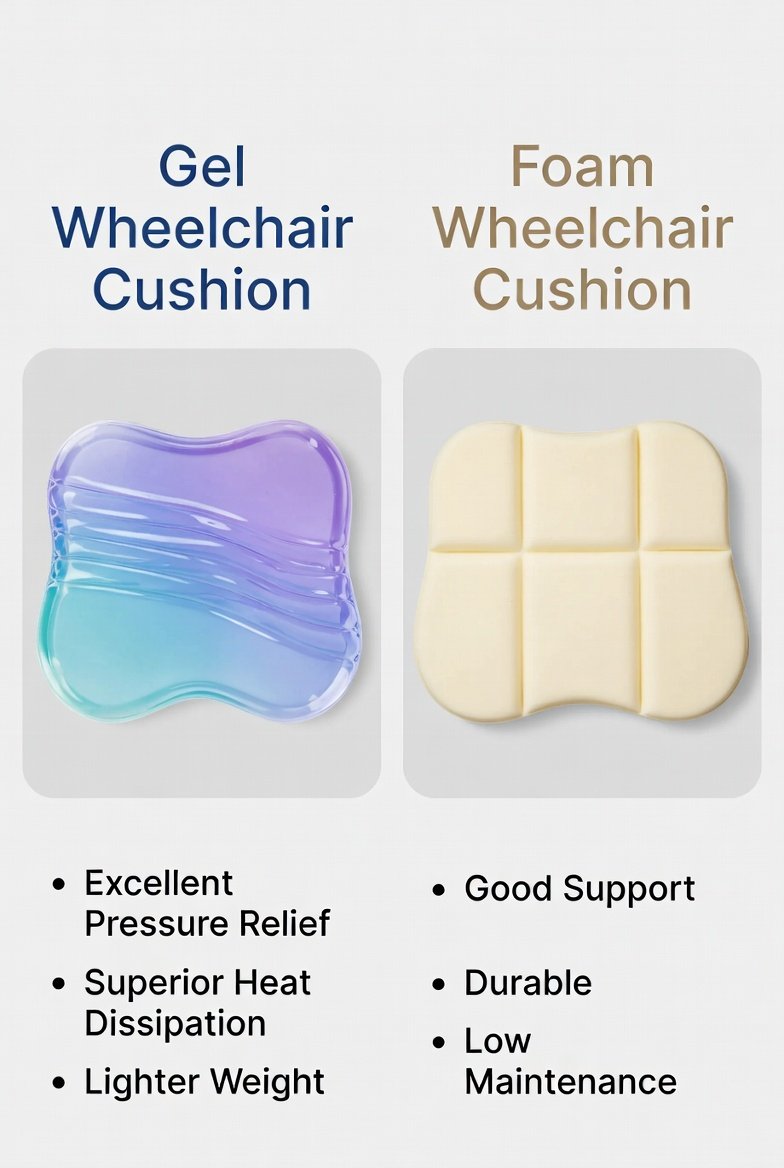
Gel vs Foam Wheelchair Cushion: Pressure Relief, Stability, Heat, and Long-Term Sitting Trade-Offs
Choosing between gel and foam wheelchair cushions is rarely about what feels softer during the first few minutes. The meaningful differences appear later — after posture settles, heat builds, pressure concentrates, and materials begin reacting to real movement.
This wheelchair cushion materials comparison explains how gel vs foam wheelchair cushions behave in everyday use. It focuses on pressure relief trade-offs, seating stability, maintenance realities, and long-term sitting comfort — without declaring a “best” option.
Because the right cushion is not the softest.
It is the one that keeps tissue protected hour after hour.
Quick Comparison Snapshot (For Fast Scanners)
Factor | Foam Cushion | Gel Cushion |
Pressure relief | Moderate, consistent | Higher, adaptive |
Seating stability | High | Moderate |
Posture control | Strong | Variable |
Heat behavior | Can trap heat | Cooler initially |
Cushion migration issues | None | Possible |
Maintenance | Low | Moderate |
Weight | Light | Heavier |
Fast takeaway:
Foam protects posture.
Gel protects sensitive tissue.
The decision usually depends on risk vs stability.
What a Wheelchair Cushion Is Actually Responsible For
A wheelchair cushion manages far more than comfort.
It must support:
- Pressure redistribution over bony areas
- Pelvic alignment and spinal posture
- Seating stability during movement and transfers
- Heat and moisture regulation
- Performance consistency as materials age
Critical Insight:
Comfort without pressure control fails medically.
Pressure relief without stability fails functionally.
The goal is balanced protection.
What Defines a Foam Wheelchair Cushion
Foam cushions rely on structural resistance.
Engineered layers compress under load while maintaining predictable shape.
This allows foam to:
- Provide stable seating
- Limit internal movement
- Support alignment
- Reduce sliding
👉 Reality: Foam prioritizes wheelchair seating stability over adaptability.
Micro Scenario
A long-time manual wheelchair user who performs frequent transfers often prefers foam because predictable firmness makes standing transitions safer.
What Defines a Gel Wheelchair Cushion
Air vs Gel cushions rely on controlled material displacement.
Instead of resisting pressure, gel flows away from it.
This enables the cushion to:
- Conform to body contours
- Reduce peak pressure points
- Improve perceived softness
- Adapt to micro-movement
👉 Reality: Gel prioritizes adaptive pressure relief over fixed structure.
Micro Scenario
Someone with developing tailbone sensitivity may experience immediate relief when switching from rigid foam to gel — provided posture remains supported.
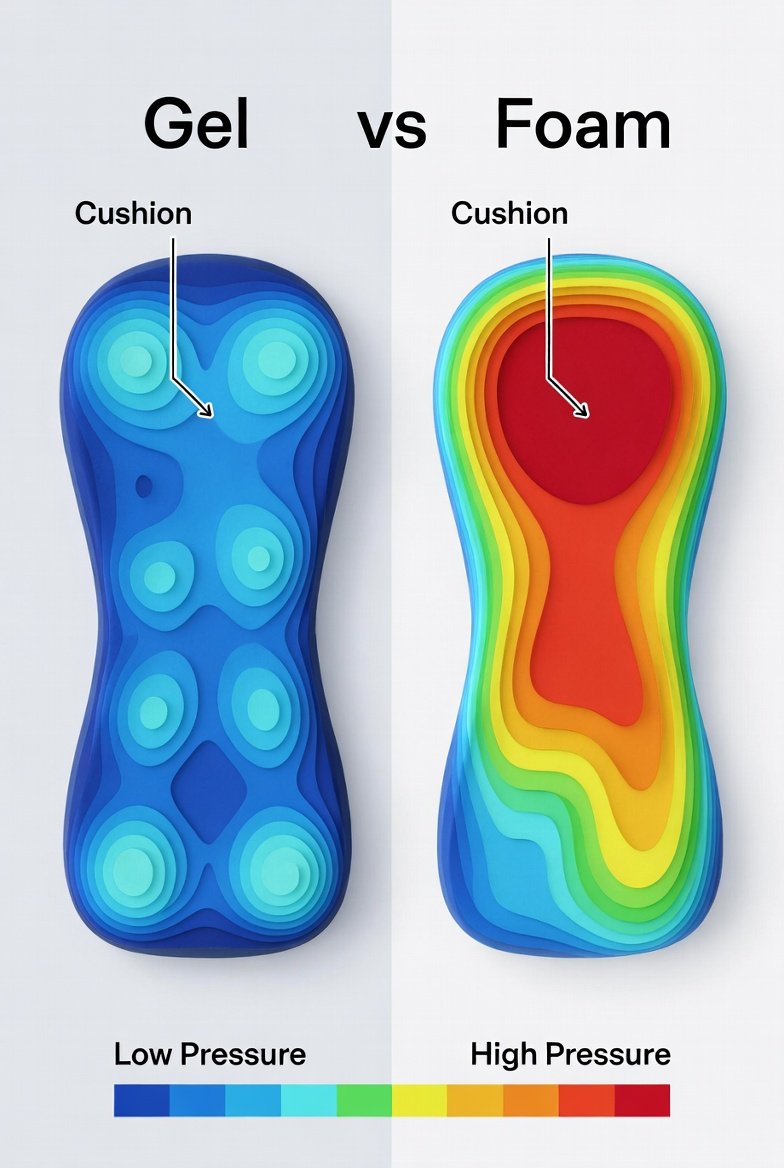
Pressure Relief Cushion Trade-Offs
Foam Pressure Behavior
Foam redistributes weight through resistance.
- Pressure relief is consistent
- High-load zones still carry force
- Performance depends heavily on density
Takeaway: Foam handles moderate pressure well — but has physiological limits.
Gel Pressure Behavior
Gel redistributes pressure dynamically.
- Material flows away from stress points
- Sensitive tissue carries less load
- Uneven gel distribution can reduce effectiveness
Takeaway: Gel improves pressure relief but requires occasional inspection.
Stability vs Comfort — The Core Materials Conflict
Most cushion decisions trace back to one tension:
Foam Cushions
- Pelvis remains centered
- Minimal side-to-side motion
- Transfers feel controlled
👉 Foam = stable, predictable seating
Gel Cushions
- Pelvis may sink slightly
- Stability varies with movement
- Transfers may feel less secure
👉 Gel = adaptive comfort with variable stability
Neither is universally better.
But misunderstanding this trade-off causes many poor purchases.
Long-Term Sitting Comfort (4–8+ Hours Daily)
Foam Over Time
- Initially firm
- Comfort remains predictable
- Compression develops gradually
Pattern:
For moderate sitting durations, foam often maintains alignment better than expected.
Gel Over Time
- Softer initial feel
- Comfort can fluctuate
- Extended sitting may shift gel away from optimal zones
Pattern:
For pressure-sensitive users who reposition consistently, gel can improve endurance.
Heat & Moisture Behavior
Foam
- Limited airflow
- Heat buildup possible
- Breathable covers become important
Gel
- Absorbs heat slowly
- Feels cooler at first contact
- May retain warmth later
Operator Insight:
Material alone rarely solves temperature issues — cover technology and airflow matter more than most buyers realize.
Movement, Transfers & Cushion Migration Issues
Foam
- Does not self-adjust
- Requires deliberate repositioning
- No migration risk
Gel
- Self-adjusts during micro-movement
- Can reduce friction
- May migrate gradually if unmanaged
👉 Hidden Risk:
Gel can sometimes mask the need to reposition — while foam exposes it.
Neither replaces movement.
Maintenance & Lifespan Reality
Cushions usually degrade slowly — not suddenly.
Foam
- Minimal daily care
- Inspect for sagging
- Replace roughly every 1–2 years depending on use
Gel
- Inspect gel placement periodically
- Rotate if recommended
- Watch for hardening or leaks
Protection Principle:
Foam asks for replacement.
Gel asks for attention.
Weight & Transport Considerations
Foam
- Lightweight
- Easier for caregivers
- Better for travel
Gel
- Heavier
- Adds lifting strain
- Less convenient for frequent vehicle loading
For active households, weight becomes surprisingly important.
Real-World Fit Check (Often Missed)
Before choosing material, evaluate:
- Daily sitting duration
- Transfer frequency
- Caregiver involvement
- Indoor temperature
- Ability to reposition
- Postural control
Mismatch here causes dissatisfaction regardless of cushion quality.
Where Foam Cushions Commonly Fall Short
Foam may struggle when:
- Sitting exceeds 6–8 hours daily
- Pressure sore risk increases
- Body weight concentrates heavily
Structure alone cannot offset elevated pressure risk.
Where Gel Cushions Commonly Fall Short
Gel may struggle when:
- Stability is critical
- Transfers occur often
- Migration goes unchecked
Comfort without control creates safety concerns.
Decision Direction (Use This Instead of Guessing)
If Your Priority Is… | Material Direction |
Posture & transfer stability | Foam |
Pressure sensitivity | Gel |
Predictable seating | Foam |
Adaptive contouring | Gel |
Lower maintenance | Foam |
Enhanced pressure distribution | Gel |
This is directional — not prescriptive.
Why This Comparison Avoids a Verdict
This page compares pressure relief cushion trade-offs, not products.
- Foam solves structure problems
- Gel solves sensitivity problems
Declaring a universal “best” ignores physiology, behavior, and environment — and often leads to poor outcomes.
The safest choice is the one aligned with risk level, movement habits, and posture needs.
Practical Next Steps
If pressure risk is emerging → explore higher redistribution options.
If transfers feel unstable → prioritize structure.
For full selection guidance:
👉 best wheelchair cushion
If pressure injury risk is a concern:
👉 wheelchair cushion for pressure sores
FAQs
Can gel cushions be used on electric wheelchairs?
Yes. Cushion material is independent of wheelchair type.
Do foam cushions lose support faster than gel?
Foam compresses gradually; gel loses effectiveness when migration occurs.
Which cushion is easier to transport?
Foam cushions are typically lighter and easier to handle.
Do gel cushions require more cleaning?
Cleaning depends mostly on the cover, but gel cushions benefit from more frequent inspection.
Is one material better for long-term sitting comfort?
Comfort depends on posture, repositioning habits, and maintenance — not material alone.
Are hybrid cushions better than foam or gel?
Hybrid designs aim to balance stability and pressure relief, but suitability depends on individual needs.